
Can you charge an e-bike battery overnight? CPSC and makers
Last checked Oct 24, 2026 · By EbikePost editors
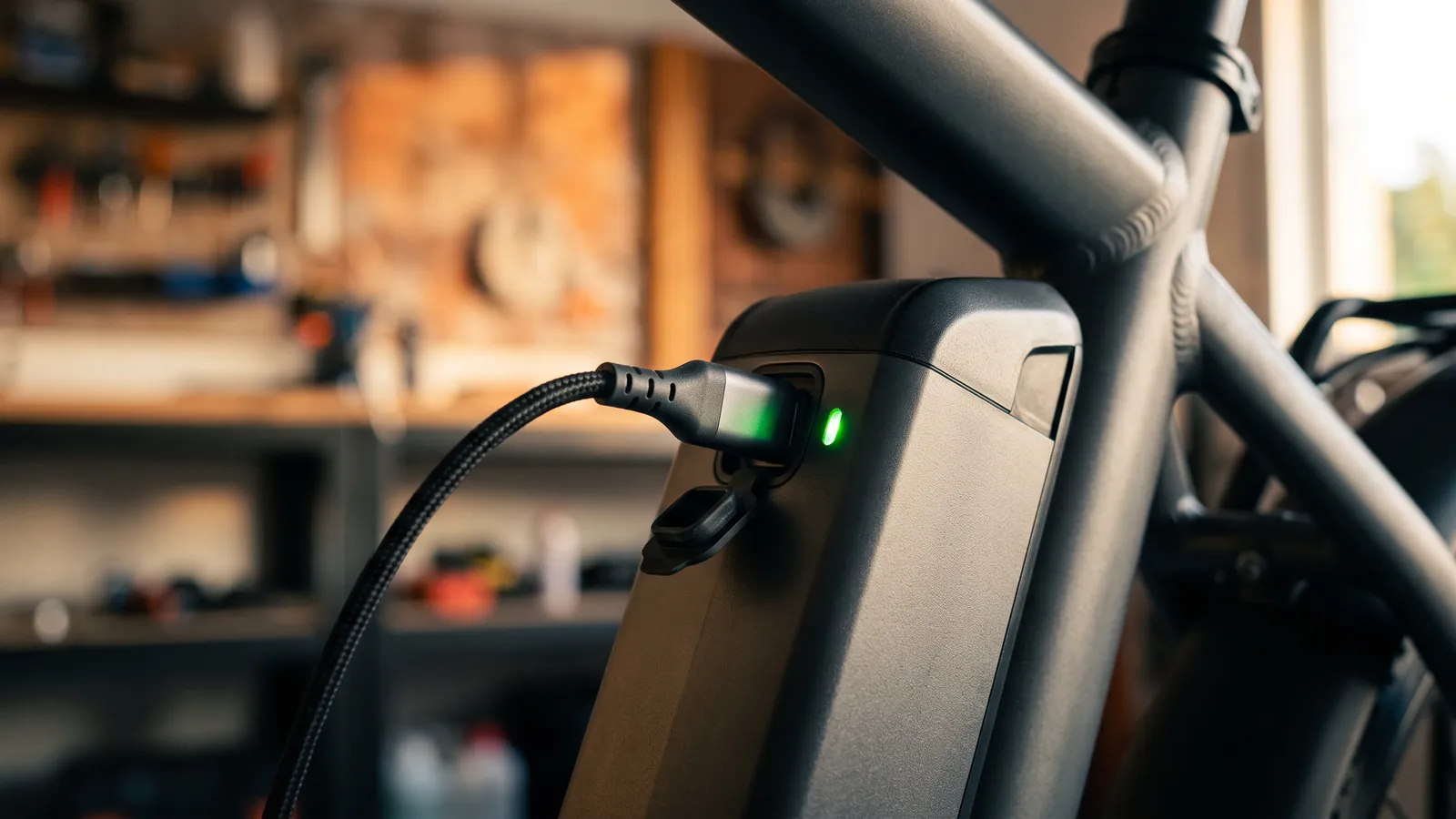
Do not charge an e-bike battery while you are asleep or away from home. That is CPSC's advice, and two makers say the same in their own words: Lectric's manual says not to leave the battery connected to the charger overnight, and Aventon says never to charge overnight. Charge when you are home and awake, with the charger that came with the bike, and unplug when it is done.
What CPSC says
The U.S. Consumer Product Safety Commission's Micromobility Information Center gives these charging rules:
- "Always be present when charging micromobility products."
- "Never charge them while sleeping or when you are not at home."
- "Only use the charger provided with or recommended by the manufacturer."
- Follow the maker's charging instructions and unplug the device when it is done.
CPSC explains why: it has seen many lithium-ion battery home fires and deaths happen at night while batteries were charging. The advice costs nothing to follow: charge while you are home and awake.
What the makers say
Many riders have heard "the charger shuts off when it is full, so overnight is fine." Some makers do say the charger stops by itself. They still ask you to disconnect.
| Maker | What it says | Source |
|---|---|---|
| Lectric | "Do not charge battery unattended or leave battery connected to charger overnight." Leaving it permanently connected is not recommended. Never use extension cords with the charger. Charge between 32 and 113 F, away from flammable materials, on a fireproof surface, with the battery dry. | XP 4 manual v1.3 |
| Aventon | "Never charge your battery overnight." Unplug when it reaches a full charge. | Aventon battery care |
| Ride1Up | Use only the supplied charger, a standard grounded wall outlet, a dry well-ventilated area, nothing flammable nearby. Avoid leaving it charging unattended for extended periods. Unplug when full or at your target (80 percent for longevity). | Ride1Up battery safety |
| Rad | The charger stops automatically when full, but disconnect as soon as possible after charging is complete and unplug it when you are not using it. Stick with the charger that came with the bike. | Rad battery health tips |
These pages do not agree on every detail. Aventon's own page also describes a battery-balancing routine with a long plug-in time, which conflicts with its "never overnight" line, so check your model's manual for any such instruction. Lectric and Aventon are firm; Ride1Up says "unattended for extended periods"; Rad does not address overnight at all and relies on unplugging promptly. The common thread is to be there and to unplug.
Charge times are long enough to plan around. Lectric's manual gives about 6 to 10 hours for a mostly empty battery, Rad about 3 to 7 hours for its standard packs. Start a charge when you will be home and awake for the whole stretch, or when you get back from a ride, and set a phone alarm for the finish.
A calmer charging routine
- Use the maker's charger only. Lectric warns that with a charger it does not make, "the risk of fire cannot be excluded." See our UL 2849 guide for what certification means.
- Plug straight into a wall outlet. Lectric says never to use extension cords with its charger. Ride1Up says use a standard grounded wall outlet.
- Charge indoors on a hard, dry surface, in a room with a smoke alarm, with nothing flammable nearby. Lectric says to place the battery on a fireproof surface before charging and to store it in a room with a smoke alarm.
- Do not charge in temperature extremes. Lectric's manual says to charge only between 32 and 113 F. See our battery-not-charging guide for temperature checks.
- Stay in the house and unplug when done. Lectric says its charger may get hot (above 165 F) and to avoid touching the body of the charger.
- Do not charge a damaged battery. Ride1Up lists swelling, cracks, unusual smells and excessive heat as signs to stop.
How often should you charge?
There is no single rule. Lectric's manual says to charge to 100 percent a few hours before you plan to ride, not days before. Ride1Up says unplugging at 80 percent is the longevity setting. Aventon says newer batteries do not need to be run down first, so top up when needed. Range depends on how you ride; see how far an e-bike can go. For longer breaks, see our winter storage guide.
If a battery or charger gets hot enough to worry you, smells odd, swells, leaks, smokes or makes noise while charging, unplug it only if that is safe, get away from it and follow your manual's emergency advice. Lectric's manual says to leave the area and notify the fire department. Do not open the battery or charger. Contact the maker afterwards.
CPSC advice: be present when charging, do not charge while sleeping or away, use the maker's charger, unplug when done. Rad owners: the CPSC warned on 24 November 2025 that batteries with model numbers RP-1304, RAD-S1304Y and HL-RP-S1304 should not be used, so check your label and read what Rad owners can do now.
Questions
Can I charge an e-bike battery overnight?
CPSC says never while sleeping or away from home. Lectric and Aventon say the same for their batteries.
Can you leave an e-bike battery charging overnight if it has an auto shut-off?
Rad says its charger stops when the battery is full but still asks you to unplug as soon as possible. CPSC's rule does not depend on the charger.
Can you charge an e-bike battery inside?
Yes. Makers ask for a dry place away from flammable items, and Lectric adds a room with a smoke alarm. Ride1Up asks for a well-ventilated area.
What are the best practices for charging an e-bike battery?
Maker's charger, wall outlet, unplug when done, be home, avoid temperature extremes, stop if it is damaged.
How often should an e-bike battery be charged?
Follow your manual. Lectric: charge fully a few hours before riding. Ride1Up: about 80 percent for longevity.
Written from CPSC material and makers' manuals. Instructions differ by maker and model: your manual decides.
Sources (6)
- CPSC Micromobility Information Center, After the Ride (be present when charging, never charge while sleeping or not at home, use the maker's charger, unplug when done)
- Lectric XP 4 User Manual v1.3 2025 (Charging Battery Pack Before and During Storage; Battery Safety warnings)
- Aventon: Taking Care of Your Ebike Battery (never charge overnight; unplug at full charge)
- Ride1Up Support: E-Bike Battery Safety, What Every Rider Should Know (charger, outlet, unattended, 80 percent)
- Rad Power Bikes: Six Tips For Electric Bike Battery Health (charger stops when full; disconnect as soon as possible)
- CPSC warning, Rad Power Bikes batteries RP-1304, RAD-S1304Y and HL-RP-S1304, 24 November 2025
Last checked Oct 24, 2026
Keep reading
 GuideE-bike battery not charging: safe checks to try firstWhy is my ebike battery not charging? Safe checks: power switch, outlet, charger light, plug, temperature and display codes. Then contact the maker.
 GuideUL 2849: what e-bike battery certification meansWhat UL 2849 e-bike certification covers, what it doesn't, how to check whether a bike has it, and where the official battery safety advice is.
 GuideHow far can an e-bike go? Ebike range explainedEbike range explained: how battery Wh, assist level, rider and cargo weight, terrain, speed and cold change range, and how to estimate yours.