
How much does it cost to charge an e-bike? The maths
Last checked Oct 30, 2026 · By EbikePost editors
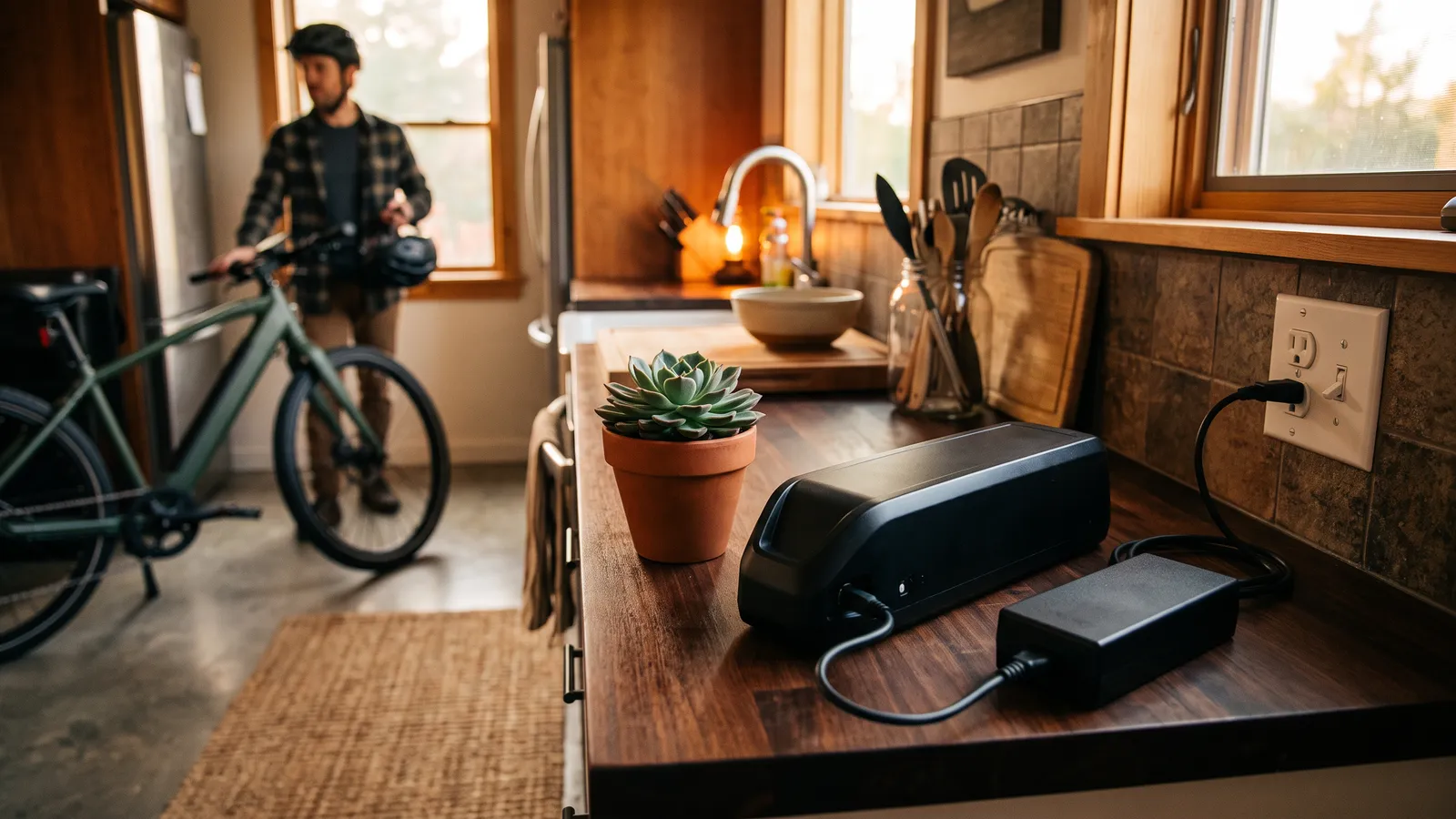
At the U.S. average residential electricity price of 18.16 cents per kilowatt-hour (EIA, August 2026), a full charge costs about 9 cents for a 500 Wh battery, 13 cents for 700 Wh and 18 cents for 1,000 Wh, before charger losses. For the Lectric XP4, whose maker claims up to 50 miles from a 500 Wh battery, that works out to roughly a fifth of a cent per claimed mile. Your own price per kilowatt-hour is on your electric bill, and that's the number that matters.
You plugged in the battery and the next thought is the bill. The answer is small, and the maths is short enough to do yourself.
The one number you need: your price per kWh
The U.S. Energy Information Administration publishes the average price of electricity by state. Its Electric Power Monthly, Table 5.6.A (released 23 October 2026) lists the U.S. total residential average retail price at 18.16 cents per kilowatt-hour for August 2026, up from 17.57 cents in August 2025. EIA marks 2026 values as preliminary estimates, and the average hides a big spread: the same table lists Nevada at 12.72 cents and Hawaii at 47.18 cents for August 2026. Look on your own bill for your rate, and note whether it has a delivery charge on top of the energy charge.
The formula
Cost per charge = battery size in kWh x price per kWh. A battery's size in watt-hours (Wh) is printed in the maker's specs. Divide by 1,000 to get kWh. A 500 Wh battery is 0.5 kWh.
Worked maths at 18.16 cents per kWh
| Battery | In kWh | Cost of a full charge from empty |
|---|---|---|
| 500 Wh | 0.5 | 0.5 x $0.1816 = $0.0908, about 9 cents |
| 700 Wh | 0.7 | 0.7 x $0.1816 = $0.1271, about 13 cents |
| 1,000 Wh | 1.0 | 1.0 x $0.1816 = $0.1816, about 18 cents |
Two limits on those figures. First, you rarely charge from fully empty, so most charges cost less. Second, the charger pulls a little more from the wall than the battery stores, and we haven't found a figure for it on the makers' pages, so the real cost is slightly higher. The meter method below captures it.
At the extremes of EIA's August 2026 state prices, the same 500 Wh charge is about 6 cents at 12.72 cents per kWh and about 24 cents at 47.18 cents per kWh.
Cost per mile, using a maker's claimed range
Cost per mile = cost per charge divided by miles per charge. Range is the soft part, so here is one example with the maker's own claim, not a test result.
The Lectric XP4 lists a 500 Wh battery and a claimed range of up to 50 miles on its product page.
- Cost per charge at 18.16 cents: $0.0908.
- $0.0908 divided by 50 claimed miles = about $0.0018 per mile, under a fifth of a cent.
- If you get half the claim, 25 miles, it doubles to about $0.0036 per mile.
"Up to" is a ceiling, so treat the 0.18 cents as the floor of the cost. Our range guide explains what moves the real number: assist level, hills, wind, cold, rider and cargo weight. A bike that carries you 20 miles a week for a year (1,040 miles) at the claimed range would use about $1.89 of electricity at the U.S. average price, and about twice that at half the range. Both figures ignore charger losses.
Your own number, in four steps
- Find your rate. Take the cents per kWh from your electric bill. Add the delivery charge to the energy charge if they're listed separately.
- Find your battery's Wh on the label or in the maker's specs. If it only shows volts and amp-hours, multiply them: a 48 V, 14 Ah pack is 672 Wh.
- Multiply: Wh divided by 1,000, times your rate.
- Optional, for the real figure: plug the charger into a plug-in electricity usage meter (the kind that shows kWh), charge from your usual level, and read the kWh used. Multiply that by your rate. Then note the miles you rode and divide.
Charging safely matters more than saving a cent. CPSC says to always be present when charging, never charge while sleeping or away from home, and to use only the charger provided with or recommended by the maker. Our overnight charging guide covers it. A meter plugged between the wall and the maker's charger is fine; never swap in a different charger to save money.
What changes the cost
- Electric rate and time of use. Some utilities charge different rates by time of day. Your bill or utility website will say.
- Battery size. Bigger batteries cost more per full charge but also usually go further.
- Battery health. As a pack ages, range tends to fall, so the cost per mile rises even though the cost per charge hasn't changed. See how long e-bike batteries last.
FAQ
How much does it cost to charge an ebike? About 9 cents for a 500 Wh battery, 13 cents for 700 Wh and 18 cents for 1,000 Wh at the EIA's August 2026 U.S. residential average of 18.16 cents per kWh, from empty and before charger losses.
How much does it cost per mile to charge an e-bike? It depends on range. With the Lectric XP4's claimed 50 miles on 500 Wh it works out to about a fifth of a cent per mile at the U.S. average price. Divide your own charge cost by your own miles.
Does an e-bike use a lot of electricity? A 500 Wh battery holds half a kilowatt-hour, so a full charge is half of one hour of a 1,000-watt appliance. The cost is small at any U.S. price in EIA's table.
How many watts is an e-bike? Motor ratings are listed in watts (the XP4's is 500 W nominal), but charging cost depends on the battery's watt-hours, not the motor rating. Use the battery's Wh.
Prices from EIA's Electric Power Monthly Table 5.6.A (August 2026, preliminary). Range figures are the makers' claims, not our measurements.
Sources (3)
- U.S. EIA, Electric Power Monthly, Table 5.6.A: Average Price of Electricity to Ultimate Customers by End-Use Sector, by State, August 2026 and 2025 (released 23 October 2026)
- Lectric XP4 product page (500 Wh battery, claimed range up to 50 miles)
- CPSC Micromobility Information Center (charging advice)
Last checked Oct 30, 2026
Keep reading
 GuideHow far can an e-bike go? Ebike range explainedEbike range explained: how battery Wh, assist level, rider and cargo weight, terrain, speed and cold change range, and how to estimate yours.
 GuideCan you charge an e-bike battery overnight? CPSC and makersCan you charge an e-bike battery overnight? CPSC says never while asleep or away. What Lectric, Aventon, Ride1Up and Rad say, and a safer routine.
 GuideHow long do e-bike batteries last? Maker cycle countsHow long do ebike batteries last? No maker promises a lifespan. Compare Bosch, Aventon and Rad warranty cycles and years, plus habits the manuals give.