
E-bike torque sensor vs cadence sensor: the difference
Last checked Nov 9, 2026 · By EbikePost editors
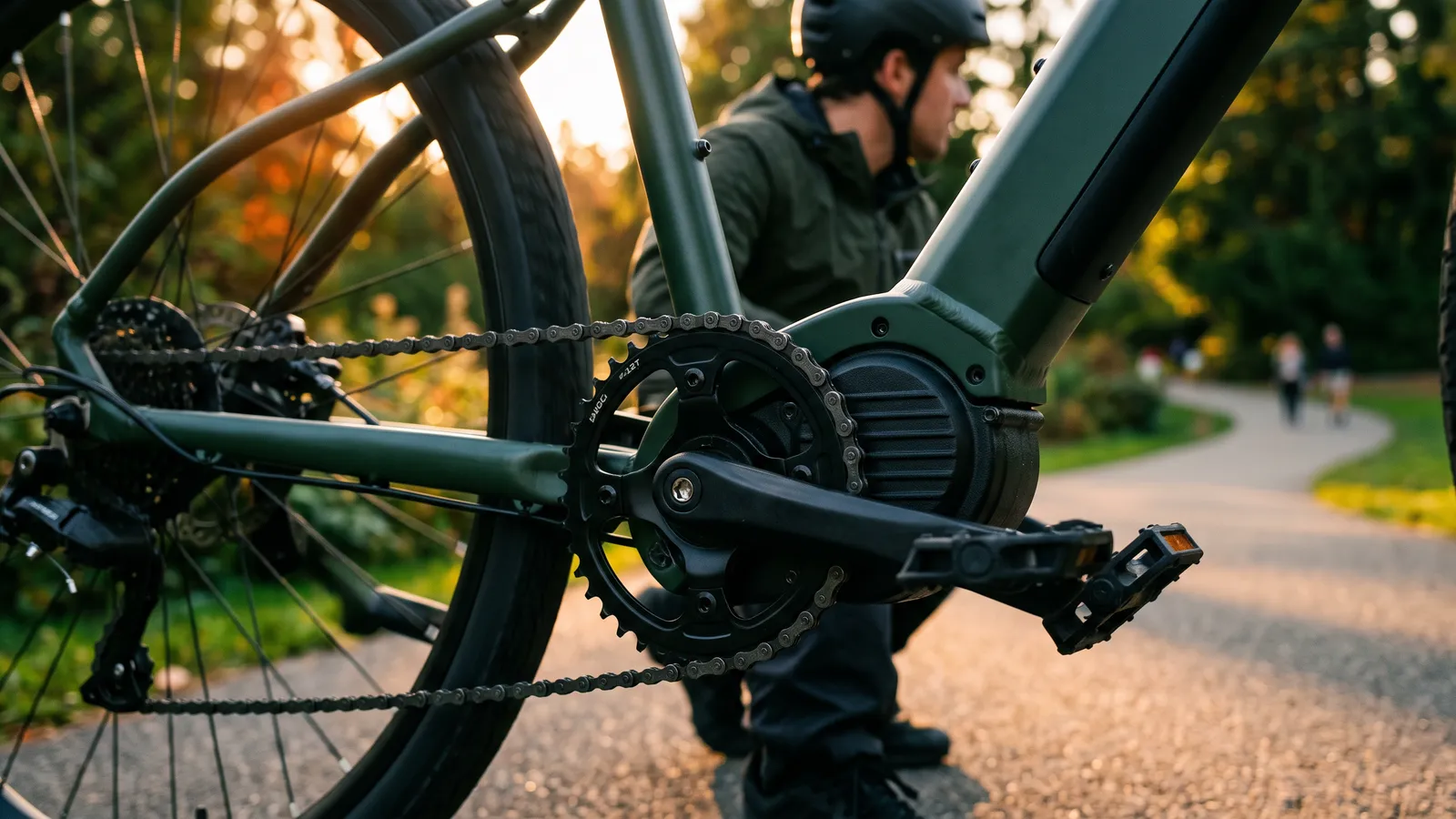
A torque sensor on an e-bike measures how hard you push on the pedals, so the motor's help can rise and fall with your effort. A cadence sensor only detects that the pedals are turning, so the motor's output follows the assist level you chose rather than how hard you're working. Torque sensors are common on higher-priced bikes, and some lower-priced bikes list one too. Check the maker's spec page: if it doesn't name the sensor, ask the maker before you buy.
What is a torque sensor on an e-bike?
It's a sensor in the drive system that reads the force going through the cranks. Bosch puts it plainly for its Performance Line CX: "The torque sensor measures how much force is exerted on the pedals." The motor controller uses that reading to decide how much to help. Push gently and you get a little assist; stand on the pedals at a green light and you get more, within the assist level you've picked.
You'll find torque sensors on mid-drive systems such as Bosch's and on hub-motor bikes too: the Aventon Abound SR and the Lectric XP4 are both recorded as torque-sensor bikes from their makers' pages.
The difference
Cadence sensor. It measures how fast the cranks turn. Bosch says its cadence sensor "measures how fast the cranks are turning." With a basic cadence-sensing system, the motor responds to pedaling and to the assist level you set. For its own system, Lectric's XP4 manual says pedal assist works only when you are pedaling, and that "the motor output always depends on your pedaling and the PAS level you have set."
Torque sensor. It measures how much force you put through the pedals. Bosch says of its Performance Line CX: "The torque sensor measures how much force is exerted on the pedals." Bosch's drive units combine that with cadence, acceleration and tilt sensors. Our bike data records the Aventon Abound SR and the Lectric XP4 as torque-sensor bikes, from their makers' pages.
Throttle is separate. A throttle lets the motor run without pedaling. Throttle bikes can be Class 2. See e-bike classes explained.
What changes on hills and in traffic
These are the editors' reading of how each method works, not ride impressions:
- Starting from a stop. A cadence system waits for the cranks to turn, while a torque system reacts to the force you apply. Lectric's manual advises pedaling when starting from a standstill.
- Hills. A torque system can raise or lower assist as your effort changes. A cadence system gives the assist your chosen level provides while you pedal. Lectric's manual says to use lower pedal-assist levels and pedal when climbing hills, to save battery.
- Traffic. Smooth, predictable assist matters when stopping and starting. Read the maker's description of start-up behavior. Bosch's pages use words such as "direct" and "responsive," which are marketing terms rather than measurements.
- Range. Assist level affects range more than sensor type does. See how far can an e-bike go.
Bikes that let you switch
You don't always have to choose. Velotric lists a "Torque and Cadence Sensor" on the Discover 3 with a feature it calls SensorSwap, and says Discover 2 owners can switch to a cadence mode as well. Velotric pitches cadence for relaxed city riding and torque for "smooth, intuitive power." Aventon lists a "Sensor Switch" on the Level 4 REC, though its spec table doesn't name the sensor types. If a bike offers both, try each on a familiar route and keep the one that suits you. See Velotric vs Aventon for those two bikes side by side.
How to find out which sensor a bike has
- Open the maker's spec page and look for "torque sensor," "cadence sensor," "PAS sensor" or "sensor type."
- Check the manual. Look in the pedal-assist (PAS) section for the sensor type.
- Check the drive-system maker. Bosch names the torque sensor on its drive-unit pages.
- Ask the maker if the page doesn't say. A "PAS sensor" with no further detail is not enough to tell.
- Check torque sensor claims against specs. A listed Nm figure is motor torque, not sensor type.
Which to choose
- Tight budget, flat routes: a cadence-sensor bike can be enough. Look for adjustable assist levels.
- Hills, loaded riding or stop-and-go routes: consider a torque-sensor bike, and look at the motor's stated torque too. See hub vs mid-drive motors.
- First-time buyers: whichever you pick, read the maker's description of how assist starts and stops.
- Check the maker's return policy if you can't try the bike first. Our bike pages show returns and warranty from the makers.
The sensor sits in the drive system. Any fault codes about sensors, such as a "PAS sensor fault" or "speed sensor fault", are listed in your manual. See e-bike error codes.
If assist cuts in and out or a sensor code appears, switch off, check the battery is seated and restart. If it continues, don't open the motor or wiring or move sensors. Contact the maker or a qualified e-bike shop.
Questions
What is a torque sensor on an e-bike?
A sensor in the drive that measures how hard you push on the pedals. The motor uses it to scale its help to your effort. Bosch describes it as measuring "how much force is exerted on the pedals."
Cadence vs torque sensor: which is better?
Neither is better for everyone. A torque sensor follows your effort, which many riders like on hills and in stop-and-go traffic. A cadence sensor gives a set level of help once the pedals turn, which suits relaxed riding on flat routes and is common on lower-priced bikes.
Can I add a torque sensor to my e-bike?
Not as an owner job. The sensor is part of the drive system and its wiring, so don't open or swap it. Ask the maker or a qualified e-bike shop.
Do torque-sensor e-bikes have a throttle?
Some do. The sensor and the throttle are separate. Velotric's Discover 3, for example, lists both a torque and cadence sensor and a throttle.
Spec-based, not ridden: these descriptions come from makers' documents and our reading of how the sensors work.
Sources (6)
- Bosch eBike Systems: Performance Line CX (torque sensor measures how much force is exerted on the pedals; cadence sensor measures how fast the cranks are turning)
- Lectric XP4 User Manual v1.3: Pedal Assist (PAS) section
- Aventon Abound SR product page and specifications (torque sensor)
- Lectric XP4 product page and specifications
- Velotric Discover 3 product page and specifications (Torque and Cadence Sensor, SensorSwap)
- Velotric Discover 2 product page (SensorSwap: switch between torque and cadence sensor modes)
Last checked Nov 9, 2026
Keep reading
 GuideHub vs mid-drive e-bike motors: which is better for you?Mid drive vs hub drive motor: how each works, what each is good at on hills, commuting and budgets, and how to read maker specs without riding.
 GuideHow far can an e-bike go? Ebike range explainedEbike range explained: how battery Wh, assist level, rider and cargo weight, terrain, speed and cold change range, and how to estimate yours.
 GuideWhat is a Class 3 e-bike? Classes 1, 2 and 3 explainedA Class 3 e-bike assists only while you pedal, up to 28 mph. How Class 1, 2 and 3 differ, where each can ride, and how to check your bike and state.