
E-bike winter care: cold batteries, salt and storage
Last checked Oct 27, 2026 · By EbikePost editors
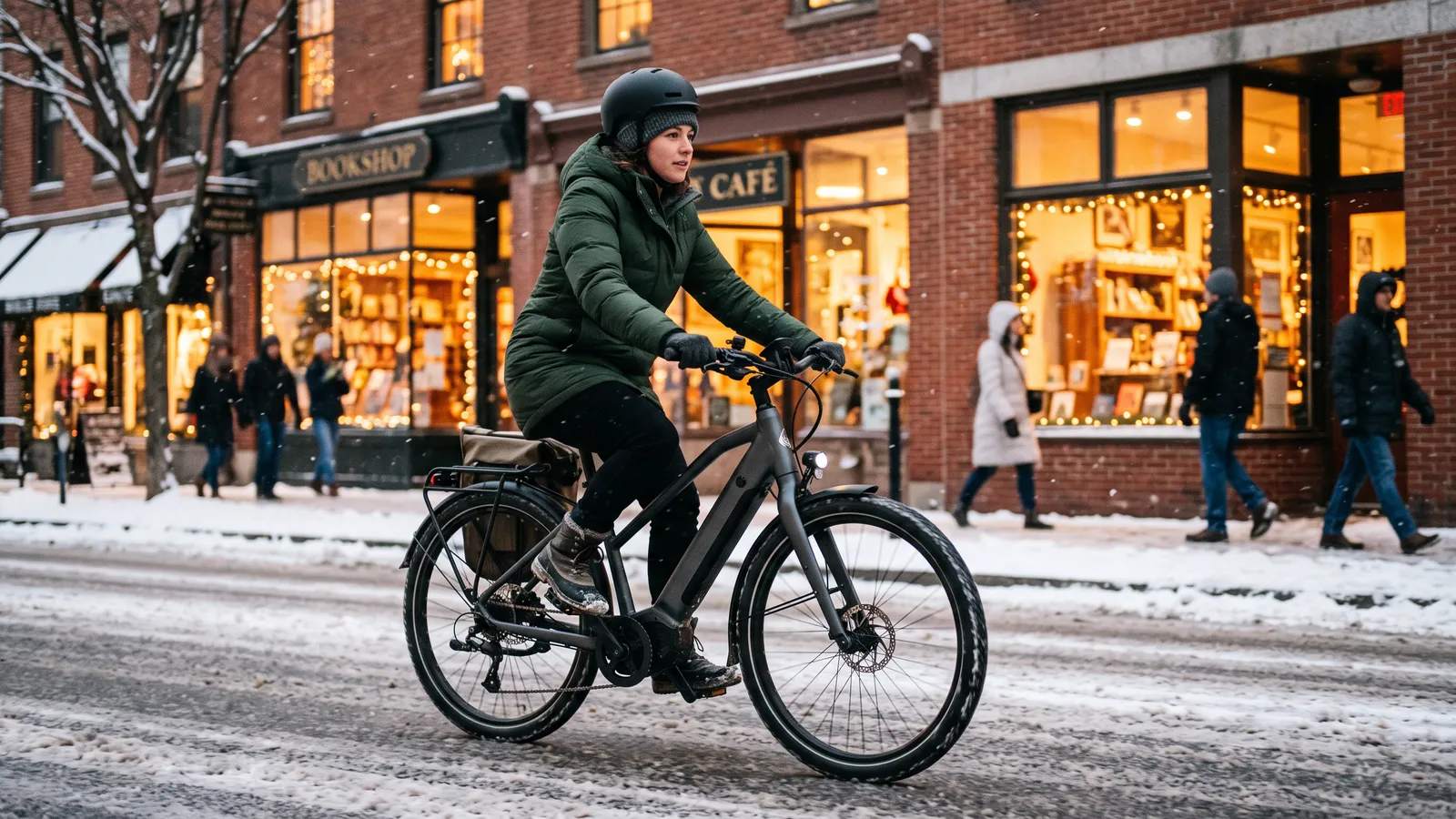
You can ride an e-bike in winter if your manual allows it, but treat the battery gently. Keep it at room temperature between rides, let it warm up before you ride and before you charge it, and charge only inside the temperature range your maker gives (Bosch and Lectric both put the lower limit at 32 F). Rinse or wipe off road salt, check tire pressure more often, and keep the chain lubed.
The bike is the easy part. Frames and tires don't care about frost the way a lithium battery does, and most winter trouble comes from the battery or from salt sitting on the bike overnight. The makers say less about cold than you'd hope, so this page sticks to what they actually publish.
The battery in the cold
Bosch's battery guide says a cold garage is harmless for a stored battery, "however, a cold battery delivers less power." Its winter article says cold lowers the battery's capacity, which can cut your range. That's the main thing you'll notice. Neither source gives a percentage, and we won't invent one. If you want the bigger picture on range, see how far an e-bike can go.
What the makers tell you to do:
- Keep it warm between rides. Bosch says that when you ride below freezing, take the battery off after the ride and keep it at room temperature, and on particularly cold days move it to a heated area and wait for it to reach room temperature before riding. Bosch also suggests thermal protective covers for longer rides in the cold.
- Skip the extremes. Rad's battery page says to try not to ride below -4 F, saying it can damage the battery. Check your own maker's operating range; many publish one. Lectric's manual, for example, gives 32 to 104 F as the operating range for the battery.
- Don't add heat. We don't cover battery warmers or heaters. Nothing we cite recommends one, and wrapping a charging battery is a risk.
A battery that's been left in a cold garage should come inside early enough to reach room temperature before you ride. That's the habit Bosch describes, and it costs nothing.
Charging in winter
Cold batteries and chargers are the trap. Lectric's manual says not to connect the battery to the charger until it has reached an allowable charging temperature, within 10 F of room temperature, and to charge only indoors in dry spaces that aren't too hot or cold. Bosch gives 32 to 104 F as the charging range, and Aventon says to charge somewhere temperature-controlled and avoid charging in extreme cold.
So: ride, bring the battery in, let it come up to room temperature, then plug in. Don't charge it overnight or when you're out; CPSC says to be present when charging and to unplug when done. See our overnight charging guide. If the bike won't charge after a cold spell, see why an e-bike battery won't charge.
Salt, slush and drying
Rad's rain guide says puddles can hold salt water after roads are salted, and that salt is corrosive and conducts electricity. Its advice is to wipe the frame and parts with a cloth dampened in fresh water, then dry the bike, and if salt water gets to the battery, to take the battery off and wipe it fully dry before putting it back.
A simple after-ride routine, in line with the makers:
- Take the battery off if your manual allows it and wipe it dry.
- Wipe the frame, fork, wheels and drivetrain with a damp cloth, then a dry one.
- Keep the bike upright and indoors if you can.
Don't use a pressure washer or submerge anything: Lectric's manual warns against both, and recommends a soft damp cloth with mild soap and water. More in can you wash an e-bike.
Tires, chain, brakes, lights
- Tires. Rad notes tires lose air as the temperature changes. Check with a gauge before riding, inside the sidewall range, as in our tire pressure guide. Schwalbe says at least monthly.
- Chain. Rad says the chain dries out faster in the colder months. Rad's rain guide suggests a wet lube for sustained wet. See our chain guide.
- Brakes. Lectric's manual says it takes longer to brake in wet conditions, and Rad says to brake earlier. Check pads while you're there: brake pad wear.
- Lights. Rad's advice is to check they're clean, functional, visible and secure, as days get shorter. See e-bike lights.
- Snow and ice. Bosch says to start without motor assistance on snow or ice, since otherwise the tires spin and slide.
Between rides
If the bike lives in a garage or outdoors, the battery should come in. See storing an e-bike outside or in a garage and a fitted cover. For a battery that will sit for weeks, the charge level depends on your maker: winter battery storage.
A battery that is swollen, cracked, leaking, hot or smells odd after a cold spell, or a bike that shows errors after riding in wet and salt, goes to the maker or a shop. Don't open the battery, motor, controller or wiring, and don't dry them with heat.
Rad owners: the CPSC warned on 24 November 2025 that batteries with model numbers RP-1304, RAD-S1304Y and HL-RP-S1304 should not be used. Check your battery's label first. See what Rad Power Bikes owners can do now.
Questions
Can you ride an e-bike in the winter?
Yes, if your manual's operating range allows it. Expect less range, take care in the wet and on ice, and see the battery habits above.
Can you leave an e-bike battery in the cold?
Bosch says a cold garage is harmless but a cold battery delivers less power, and to warm it to room temperature before riding. Aventon says a cold garage can cause damage. Your maker decides.
How do I keep my e-bike battery warm in winter?
Keep it indoors between rides. Bosch also mentions thermal covers for long rides. We don't recommend heaters.
Should I charge a cold e-bike battery?
Let it warm up first. Lectric says to wait until it's within 10 F of room temperature.
Does salt damage e-bikes?
Rad says salt is corrosive and conducts electricity. Wipe it off with a damp cloth and dry the bike.
Written from makers' manuals and support pages, not from winter rides or tests. Your manual decides.
Sources (9)
- Bosch eBike Systems: Your eBike Battery Guide (charge at 32 to 104 F; cold garage harmless but a cold battery delivers less power; warm up to room temperature before riding; thermal covers)
- Bosch eBike Systems: Safely through the winter with the eBike (remove the battery after riding below zero and keep it at room temperature; capacity loss in cold; start without assist on snow and ice)
- Lectric XP 4 User Manual v1.3 2025 (do not connect the charger until the battery is within 10 F of room temperature; charge 32 to 113 F; clean with low-residue cleaner and dry; no pressure washer)
- Rad Power Bikes: Tips for Maximizing Your Battery Life (try not to ride below -4 F)
- Rad Power Bikes: Five Tips for Riding Into Winter (tires lose air as temperature changes; chain dries out faster; check lights)
- Rad Power Bikes: How to Ride an Ebike in the Rain (salt: wipe with a cloth dampened in fresh water, dry; wet lube; brake earlier)
- Aventon: Taking Care of Your Ebike Battery (charge in a temperature-controlled place, avoid charging in extreme cold)
- Schwalbe: Tire pressure (use a gauge; check at least monthly)
- CPSC warning, Rad Power Bikes batteries RP-1304, RAD-S1304Y and HL-RP-S1304, 24 November 2025
Last checked Oct 27, 2026
Keep reading
 GuideHow to store an e-bike battery for winter: what makers sayWinter e-bike battery storage: the charge level and temperature from Bosch, Lectric, Rad, Aventon and Ride1Up side by side, plus where to keep it.
 GuideCan you wash an e-bike? Hose, bucket and what to avoidCan you wash an e-bike or hose it down? Lectric, Aventon, Bosch and Rad say no pressure washer. A bucket-and-sponge routine and the parts to keep dry.
 GuideE-bike tire pressure: how to set PSI for your tiresWhat should my e-bike tire pressure be? Start from the sidewall range, use a gauge, adjust for load within limits, per Schwalbe, Lectric and Aventon.